

Have you ever had an end user call you in distress because their power wheelchair has suddenly died? It’s not just inconvenient, and limits participation—it’s also a major safety risk, particularly if they happen to be stranded out in the community. And often, the culprit is the battery.
When it comes to powered mobility, the battery isn’t just hardware. It’s the difference between making it through an entire week of school camp with independence or having the battery die the day before leaving - a situation that I have unfortunately seen firsthand.
With so many considerations that must be weighed throughout a powered wheelchair prescription, it can be tempting to delegate battery choices and follow-up to technicians. However, a siloed approach like this risks safety issues, unnecessary costs ,and poor outcomes (like not having access to your power chair on the week of a school camp!).
Battery management must be a collaborative process, and clinicians must be proactive in leading this conversation.
Why Clinicians Are Central to Battery Decisions
Here’s why your input matters more than you might think:
- Clinical context matters
Battery selection and maintenance impacts everything, from how far the chair can drive in the community, to how convenient it is to travel by air —all tied to functional goals. - Beyond technical specifications
Technicians know the hardware. You know the person—their routines, environments, and goals. If that insight is not applied to the right technical specifications, successful outcomes will be much harder to achieve. - Risk reduction
The wrong battery or poor maintenance over time can lead to breakdowns, reduced participation, and even harm during community mobility.
So as a clinician, what information do you need to know about batteries to best support end users?
Battery Basics
Most powered wheelchairs or assistive technology devices use one of two types of rechargeable batteries:
Sealed Lead Acid (SLA)
These are the traditional batteries most commonly found in complex powered wheelchairs. In this category, you’ll typically see two sizes:
- Group 34 – Medium-sized, around 60Ah.
- Group 24 – Larger capacity, around 75Ah.
These batteries are reliable and cost-effective, but they’re heavier and require consistent charging habits to maintain performance over time.

Lithium-Ion
This newer technology is lighter and more energy-dense than SLA batteries. Because they can be configured into compact, lightweight designs, lithium-ion batteries are more commonly used in power assist devices. They offer longer life and faster charging, but compatibility depends on the wheelchair’s design.

💡Tip: Wheelchairs are designed for specific battery types—changing chemistry after purchase is rarely an option. If a chair is built for SLA batteries, switching to lithium-ion isn’t recommended (and often not possible).
Best Practices for Battery Maintenance
Educating end users about battery care is one of the simplest ways to prevent premature failure. Here are practical tips to share at delivery and during follow up:
- Charge overnight
Think of it like charging your phone— eight hours overnight is a recommended charging routine. - Avoid short charging sessions
Quick top-ups or sporadic charging shortens battery life. - Never let batteries go completely flat
Deep discharging degrades battery chemistry and impacts longevity. - Use the right charger
Stick with the one supplied at the time of delivery. Mixing chargers can cause damage and cause safety risks.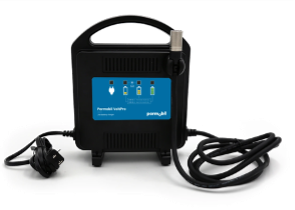
- Mind the environment
Charge in a cool, dry place. Extreme heat or cold shortens battery life. - Long-term storage
If unused for a while, fully charge the battery and disconnect at the circuit breaker. - Break-in new batteries
Give them three to four full charge cycles to reach peak capacity. - Replace like-for-like
Always match the original battery type and specs e.g. replace Group 24’s with Group 24’s.
Supporting Travel by Air
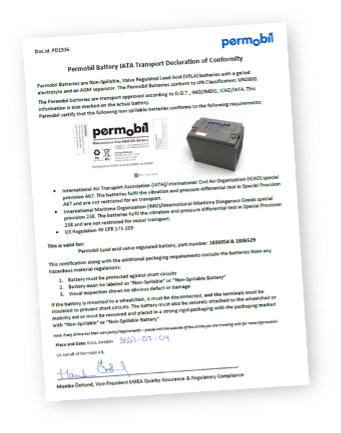
Air travel with a power chair or power assist device can feel daunting, but being well-prepared can ensure a smoother travel experience. Airlines around the world vary, but the International Air Transport Association offers guidance. At a minimum, end users or their families must:
- Provide device details—manufacturer, model, weight, dimensions.
- Provide battery information—type, capacity, and how it’s secured.
- Seek airline approval—ideally 48 hours before departure.
At Permobil, we are here to help users prepare with battery compliance certification and a detailed travel checklist to support a more stress-free flying experience. Follow the link here to find these documents on our website.

Final Thoughts
Your role doesn’t end at prescribing the chair—it extends to ensuring that every component within that chair, including the battery, supports your client’s goals and remains functional for as long as possible. By leading the battery conversation and collaborating with technicians and end users, you reduce the risk of breakdowns and protect independence, safety, and performance.
When clinicians take the lead on battery decisions, you’re not just reducing the risk of premature failures—you’re maximising outcomes and freedom for end users.

Ben Gommers BAppSc/ MPT
Clinical Services Specialist
Ben Gommers joined Permobil as a Clinical Services Specialist with his background in Complex Disability and Assistive Technology. After graduating from La Trobe University with a Bachelor of Health Science and a Masters of Physiotherapy, Ben has dedicated his career to improving the quality of life for individuals with complex health needs and disabilities.
Throughout his career, Ben has worked across various settings, including a Cerebral Palsy Early Intervention Centre, a Specialist School for students with physical disabilities and complex health conditions, and as an Assistive Technology consultant. He has witnessed firsthand the incredible impact of Assistive Technology and is inspired by its ability to empower individuals to live more independently.
More recently, Ben has enjoyed opportunities to educate and mentor other therapists, sharing his experiences and insights to help build their confidence and knowledge in Assistive Technology. He aims to ensure that both new and experienced therapists can achieve successful outcomes for wheelchair users through client centered and evidence-based practices.